How to Interpret an Anion Gap Calculator Result
What the Anion Gap Measures
The anion gap is a useful way to look at acid-base balance through everyday blood chemistry. It assists estimate the relationship between positively charged ions and negatively charged ions in the blood, especially when reviewing serum sodium, serum chloride, and serum bicarbonate. Because many important ions are not directly measured on a standard panel, the anion gap acts as a practical window into unmeasured anions and, indirectly, unmeasured cations.
In basic terms, the anion gap reflects electroneutrality, the principle that blood must remain electrically balanced. When the measured values from a basic metabolic panel are compared, the result can signal whether there is an acid-base disorder such as metabolic acidosis. That is why the anion gap is such a important diagnostic tool in routine lab interpretation.
The calculation does not identify a disease by itself. Rather it helps guide the differential diagnosis and place a laboratory result into clinical context. A normal value can be encouraging, but it does not always exclude a serious problem. Likewise, an abnormal value should be interpreted with the rest of the serum electrolytes, the patient’s symptoms, and any relevant history of illness or medication exposure.
How an Anion Gap Calculator Works
An anion gap calculator uses a basic formula to the results in a standard electrolyte panel. The most common version uses sodium, chloride, and bicarbonate to estimate the gap between measured cations and anions. Because these are common components of a basic metabolic panel, the calculation is simple to perform and often appears automatically in laboratory results.
Although the exact formula can change by laboratory, the classic approach is:
Anion gap = serum sodium - (serum chloride + serum bicarbonate)
Some labs use slightly different methods or include potassium in special cases, but the core idea stays the same. The calculator is not measuring a single substance. Instead, it is a mathematical shortcut that captures how much “gap” exists after the measured serum electrolytes are included. That gap reflects the presence of acids, proteins, or other ions not directly measured by routine testing.
Used well, the calculator supports a wider diagnostic evaluation. It helps clinicians assess whether the pattern looks like high anion gap metabolic acidosis, a normal anion gap process, or a low anion gap pattern that may point to another issue. The value should under no circumstances be interpreted in isolation; it is one part of a larger blood chemistry picture.
Standard Limits and Reference Values
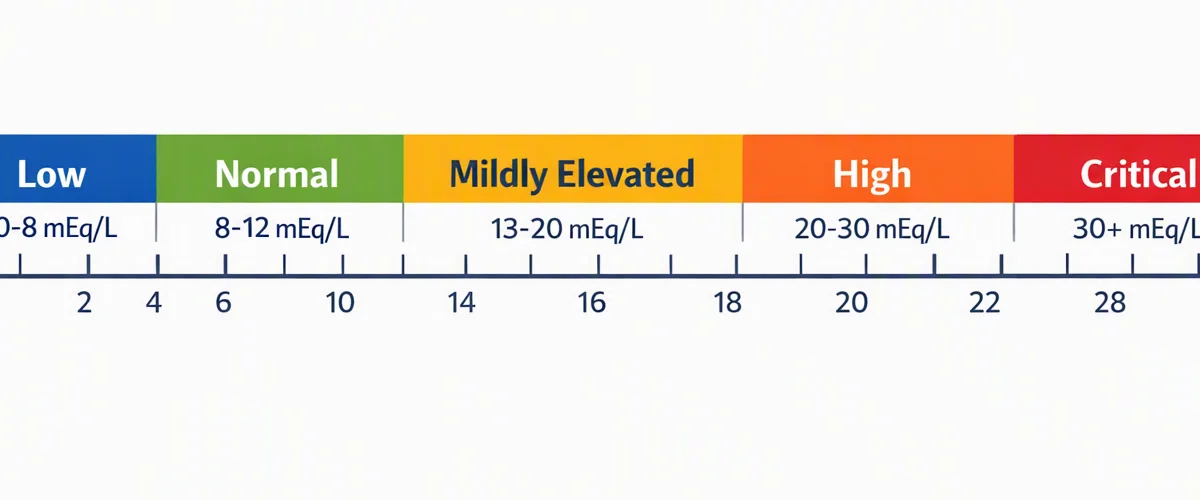
The typical anion gap is not consistent across all lab. One reference range may vary depending on the analyzer, calibration method, and whether potassium is included. This is why laboratory variation matters so much in lab interpretation. A result that seems slightly high in one setting may still fit inside expected limits in another.
Albumin also influences the expected range. Since albumin is a negatively charged protein, lower levels can lower the measured anion gap even when the underlying acid-base state is abnormal. For that reason, a “normal” result can sometimes be unreliable if hypoalbuminemia is present.
As a practical rule, match the result with the specific lab’s printed reference interval rather than basing it on a single universal number. Note whether the test was drawn as part of a basic metabolic panel or a broader electrolyte panel, and review whether other values suggest an electrolyte imbalance or a broader metabolic disturbance. The reference range is a guide, not an endpoint.
Understanding a High Anion Gap
A raised anion gap metabolic acidosis typically indicates there are extra acids in the blood or a buildup of unmeasured anions. This pattern deserves attention because it may signal an urgent metabolic acidosis. This finding is commonly accompanied by low bicarbonate and may be accompanied by clinical findings such as rapid breathing, confusion, nausea, or weakness.
Typical causes include lactic acid buildup, ketotic acidosis, renal insufficiency, uremia, toxic alcohols, and salicylate toxicity. Every cause follows a different clinical pattern. For example, lactic acidosis can occur with tissue hypoperfusion or severe infection, while ketoacidosis is often associated with insulin deficiency or prolonged fasting. Toxic exposures should be considered when the presentation is sudden, severe, or unexplained.
In practice, a high result from an anion gap calculator should trigger a search for the underlying cause rather than a focus on the number alone. Review the full clinical picture, including medications, kidney function, glucose, lactate, and ketone status. If the elevation is marked, the pattern may represent a significant acid-base disorder that requires prompt attention.
Understanding a Normal or Decreased Anion Gap
A normal anion gap metabolic acidosis can occur when bicarbonate is lost but the gap remains unchanged because chloride rises to compensate. This pattern is sometimes called hyperchloremic metabolic acidosis. It often points toward digestive bicarbonate loss, certain kidney problems, or other causes of non-gap acidosis. The key is to note that a normal gap does not mean no acidosis is present.
A low anion gap is less common and is often overlooked. One of the most frequent explanations is low albumin, because reduced albumin lowers the expected gap. Another important consideration is multiple myeloma, where abnormal proteins can alter the balance of charged particles in blood. Laboratory artifact, medication effects, or unusual ion patterns can also play a role.
When the result is unexpectedly low, run again the analysis if needed and review the entire blood chemistry profile. A low value can be a clue to an underlying disease, but it may also reflect a technical issue or an unrecognized shift in serum electrolytes. The safest approach is to interpret it alongside the rest of the data and the patient’s symptoms.
Albumin Correction and Its Clinical Significance
The adjusted anion gap reflects the effect of albumin on the lab result. Since albumin is among the key unmeasured anions, low levels can hide a true acid-base disorder. That is why albumin correction is so important when the measured gap looks normal or only mildly abnormal.
In general, a reduced serum albumin means the expected gap should be adjusted upward. The exact adjustment may vary by institution, but the purpose is the same: to avoid missing metabolic acidosis that is being masked by hypoalbuminemia. If the corrected value is elevated, the patient may actually have a high anion gap metabolic acidosis despite a deceptively ordinary initial number.
Applying the corrected value improves anion gap correction and helps align the lab finding with the patient’s physiology. This step is especially helpful in critically ill patients, those with chronic illness, or anyone whose albumin is known to be low. In other words, correction makes the diagnostic tool more accurate in real-world clinical context.
Typical Origins and Medical Setting
The most useful reading is obtained by pairing the value with the likely source. Renal failure can raise the gap because acids are not cleared and uremia contributes to the collection of unmeasured compounds. Sepsis may drive lactate production and lead to lactic acidosis. Ketoacidosis may arise in diabetes, alcohol use, or prolonged deprivation. These patterns all represent different forms of metabolic disturbance, but they can coexist on a laboratory panel.
Salicylate toxicity and toxic alcohols are especially essential not to miss because they can lead to severe abnormalities and require urgent treatment. The anion gap does not pinpoint the toxin, but it can increase suspicion early. In a patient with altered mental status, unexplained acidosis, or a sudden change in the electrolyte profile, these causes should move high on the list.
Patient context matters because the same laboratory result can indicate different things in different patients. For example, a modest elevation in a stable outpatient may warrant a different response than a similar value in a critically ill patient with worsening acid-base balance. The calculator is best used as part of a broader diagnostic evaluation, not as a standalone answer.
Step-by-Step Reading Process
A reliable workflow renders anion gap interpretation more consistent and less prone to overlook key findings. Begin with the electrolyte panel and check the sodium, chloride, and bicarbonate values used in the calculation. Then compare the result with the lab’s reference range. Then decide whether the pattern suggests a normal anion gap, a high anion gap metabolic acidosis, or a low anion gap.
Then, assess acid-base status with a blood gas if available. The blood gas assists to confirm whether there is true acidemia or alkalemia and can distinguish mixed disorders. If the anion gap is elevated, calculate the delta gap to detect additional acid-base processes. This step is especially useful when the bicarbonate drop does not match the degree of gap elevation.
A useful sequence is:
- Review the serum sodium, serum chloride, and serum bicarbonate.
- Check the reported result from the anion gap calculator.
- Check for albumin abnormalities and use corrected anion gap interpretation.
- Look for clues to lactic acidosis, ketoacidosis, renal failure, or toxin exposure.
- Use the delta gap when mixed disorders are possible.
- Interpret the result with the patient’s symptoms and overall clinical context.
This structured approach supports better lab interpretation and reduces overreaction to a single laboratory result. It also renders the process easier to repeat when serial labs are collected.
When to Seek Further Evaluation
More evaluation is needed when the result is far outside the expected range, when there is a sudden change from prior testing, or when the pattern does not fit the clinical picture. Critical values should be treated seriously, especially if the patient has concerning clinical symptoms such as shortness of breath, chest pain, confusion, vomiting, or reduced level of consciousness.
If the result looks out of sync with the patient’s condition, retesting can help confirm whether the value is real or due to sample handling, the timing of collection, or analyzer variation. In some cases, a confirmatory arterial blood gas is needed to more clearly assess acid-base status. This is especially important when there is suspected metabolic acidosis or a mixed disorder that needs careful follow-up.
Get prompt reassessment when the anion gap is abnormal and the patient has increasing symptoms, suspected poisoning, signs of shock, or delta ratio formula kidney dysfunction. A calculator is a helpful starting point, but it does not take the place of careful medical review, repeat measurement, or broader diagnostic evaluation when the situation is not stable.
Frequently Asked Questions
What is an anion gap calculator used for?
An anion gap calculator is used to interpret routine blood chemistry and help identify patterns of metabolic acidosis. It uses the values from a basic metabolic panel or electrolyte panel to determine whether there are extra unmeasured acids or other abnormalities affecting acid-base balance. It is a practical diagnostic tool for lab interpretation.
What does a high anion gap mean?
A high result often points to high anion gap metabolic acidosis, which can be caused by lactic acidosis, ketoacidosis, renal failure, uremia, toxic alcohols, or salicylate toxicity. The meaning depends on the patient’s clinical context, symptoms, and other lab findings.
Can low albumin affect the anion gap?
Yes. Albumin is a major unmeasured anion, so hypoalbuminemia can reduce the measured anion gap. That is why corrected anion gap interpretation and albumin correction are essential when the value seems unexpectedly normal or low.
What is the normal anion gap range?
The usual anion gap depends on the lab’s reference range and the analytical method. Because of testing variation, the best approach is to use the range reported with the test result. Always read it together with blood electrolytes and the rest of the chemistry panel.
When should an abnormal anion gap be evaluated further?
An abnormal result should be evaluated further when it is a critical value, when it does not match the patient’s symptoms, or when there is concern for a significant illness such as acid buildup, poisoning, kidney dysfunction, or sepsis. A repeat test, a gas analysis or ABG, and review of the gap difference may be needed to determine the acid-base imbalance.