Anion Gap Calculator: How the Equation Works and What Results Mean
What Is the Anion Gap?
The anion gap is an approach for estimating the equilibrium between electric particles, or electrolytes, in the blood. It is a practical blood chemistry concept that helps doctors identify an acid-base disorder or an electrolyte imbalance. While the name sounds technical, the idea is simple: the result reflects the difference between major positively charged and negatively charged substances measured in a serum test.
In practice, the anion gap is often discussed with sodium and chloride, along with serum bicarbonate. These values are part of a standard electrolyte panel and help create an overview of acid-base balance. The anion gap is not a direct measurement of a single chemical. Instead, it is an anion difference that gives a clue about unmeasured ions in the bloodstream.
Doctors use this number as a diagnostic aid because it can help show whether there is excess acid in the body, a change in the buffering system, or another metabolic issue. While the result is often reviewed with other lab values, it is especially helpful when evaluating possible metabolic condition concerns that involve an acid load.
Equation and Formula for Anion Gap
The equation for the anion gap is usually expressed as:
Anion gap = Sodium - (Chloride + Bicarbonate)
This represents the most common anion gap equation used in everyday practice. Some versions include potassium, but today’s calculations leave it out because the impact is typically minimal in Get more info day-to-day reading. When potassium is included, the equation becomes:
Anion gap = Sodium + Potassium - (Chloride + Bicarbonate)
The primary purpose of the formula is to contrast measured cations and anions in a way that shows the space left by unmeasured ions. In other words, the number may reveal anion gap clinical significance whether there is an increase in acids or a change in charged particles that alters the body’s chemical balance.
The formula is most helpful when considered alongside the rest of the laboratory result and the person’s symptoms. On its own, the number is an interpretive tool, not a diagnosis. Still, it can point toward patterns such as high anion gap or low anion gap, both of which may be clinically important.
How the Anion Gap Calculator Works
An Anion Gap Calculator is a calculation aid that uses the anion gap equation on its own once you enter the formula input values. Most of the time, the required input values are serum sodium, serum chloride, and serum bicarbonate. Some versions also allow potassium to be added for a more complete calculation.
The calculator acts as a fast screening tool and a handy medical reference. Instead of working out the numbers by hand, you enter the numbers from a laboratory result, and the tool displays the anion gap right away. This can be helpful for understanding, chart review, or a quick initial review at possible electrolyte imbalance.
Here is the basic method:
- Input the serum sodium value.
- Provide the serum chloride value.
- Input the serum bicarbonate value.
- Optionally enter potassium if the calculator supports it.
- Review the calculated anion gap and compare it with the expected reference range.
The calculator is best understood as a diagnostic aid rather than a stand-alone answer. A number outside the expected range can be significant, but the clinical interpretation depends on the situation. The same laboratory result can mean different things depending on medications, kidney function, nutrition status, and other blood chemistry findings.
Standard Anion Gap Range and Interpretation
The typical range for anion gap depends on the approach used by the laboratory, so the reference range can differ. That is one reason the printed laboratory result should always be interpreted together with the lab’s own standards. A value that seems abnormal in one lab may be normal in another if the measurement method varies.
One important consideration in interpretation is albumin. Albumin carries a negative charge, so lower albumin can lower the measured anion gap even when the person’s acid-base status has changed. This is why adjustment for albumin may be needed. A adjusted anion gap can provide a better estimate when albumin is low and the raw value may be misleading.
In general, the anion gap helps assess acid-base balance. A normal result often suggests that major unmeasured acids are not accumulating, though it does not eliminate every problem. A result higher than or under the expected range should be considered with the full clinical picture, including symptoms, other labs, and the reason the test was ordered.
Common ways to interpret it include:
- Expected range: often consistent with balanced measured electrolytes, depending on the reference range used.
- High anion gap: may suggest extra acids in the blood.
- Reduced anion gap: may reflect albumin changes, measurement issues, or less common conditions.
High Anion Gap Metabolic Acidosis Causes
A high anion gap is often linked to acidic metabolic imbalance, which means the body has too much acid or too little buffering capacity. This pattern is one of the main reasons clinicians use the anion gap in the first place. It can suggest an increase in unmeasured acids that alter the blood’s chemical balance.
Common causes include lactic acidosis, ketone buildup, and impaired kidney function. In lactic acidosis, lactate builds up when tissues do not get enough oxygen or when metabolism is disrupted. In ketoacidosis, acids called ketones rise, often in the setting of insulin problems, fasting, or other metabolic stress. In renal failure, the kidneys cannot remove acid as effectively, so acid accumulates.
Other causes of high anion gap metabolic acidosis may be present as well, but these three are among the most commonly discussed. The specific cause matters because treatment depends on the underlying problem, not just the number itself.
Symptoms may include fatigue, nausea, mental clouding, rapid breathing, or other signs of illness, but symptoms alone do not confirm the cause. The anion gap is one piece of the clinical interpretation puzzle and should be considered with the blood test context and the person’s overall condition.
Reduced Anion Gap Causes and Medical Significance
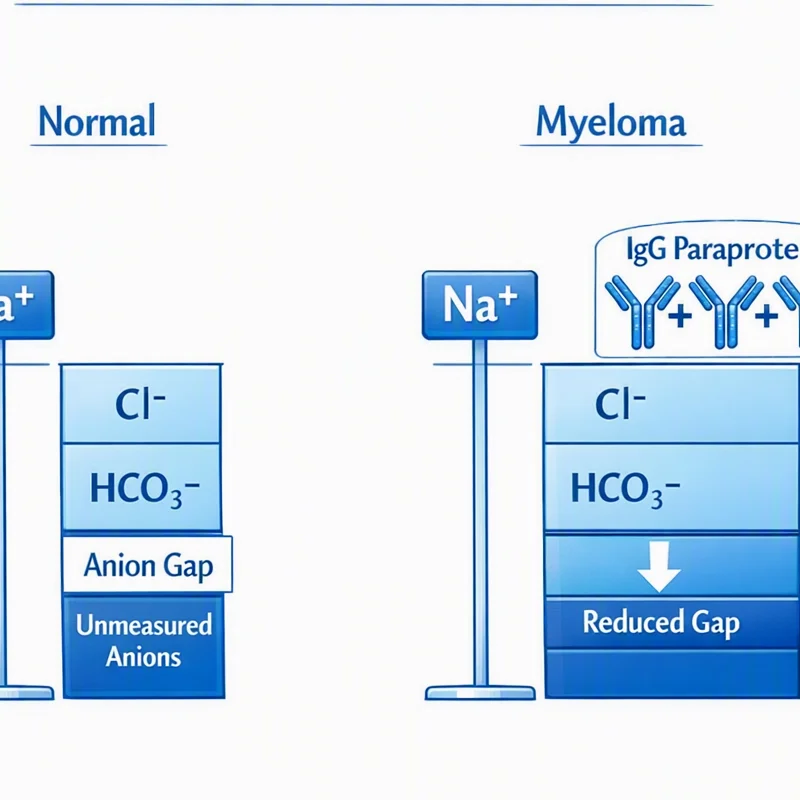
A decreased anion gap is rarer than a elevated result, but it can still be medically important. One of the most common explanations is hypoalbuminemia, because albumin contributes to the normal balance of negative charge in blood. When albumin is low, the calculated gap may fall even if nothing else is wrong with the formula.
Another important cause is lab error. Because the anion gap depends on reliable measurement of sodium, chloride, and bicarbonate, any error in the underlying lab values can alter the result. That is why an surprisingly low value often leads to a repeat measurement or a closer review of the electrolyte panel.
Uncommon but important causes include multiple myeloma, a condition in which abnormal proteins can disrupt the charge balance in blood. In such cases, the low anion gap may be a clue that requires further evaluation.
Its meaning in practice depends on the context. Sometimes a low result is mainly due to albumin and has little immediate significance. Other times it may suggest a more serious issue. If the result does not fit the rest of the blood chemistry picture, clinicians often consider albumin correction and verify the laboratory result before drawing conclusions.
Detailed Sample Calculation
An example calculation can render the anion gap formula more straightforward to grasp. Suppose a person has the these values:
- Serum sodium: 140
- Serum chloride: 104
- Bicarbonate level: 24
Applying the standard equation:
Anion gap = Sodium - (Chloride + Bicarbonate)
Begin by adding chloride and bicarbonate: 104 + 24 = 128. Afterward subtract that total from sodium: 140 - 128 = 12.
Therefore the anion gap is 12.
If the calculator includes potassium, the steps are essentially the same. As an example, if potassium were 4, the calculation would become:
Anion gap = 140 + 4 - (104 + 24) = 16
This basic illustration shows why the exact formula is important. A calculator can reduce mistakes and accelerate review, but the result still needs interpretation within the clinical context. The value should be compared with the laboratory’s reference range and considered alongside other findings such as albumin, kidney function, and possible acid-base disorder signs.
When to Seek Medical Review
Anyone reviewing an anion gap result should remember that this is a laboratory tool, not a diagnosis by itself. A medical professional can read the number in the context of the full lab test and the rest of the chemistry panel. That broader clinical assessment helps determine whether the finding is expected, warrants repeat testing, or points to a specific problem.
Medical review is especially important if the result is clearly outside the normal range, if there are symptoms, or if there are concerns for metabolic acidosis, renal failure, ketoacidosis, or lactic acidosis. It is also important when the value is low and may be explained by hypoalbuminemia, multiple myeloma, or lab error.
The anion gap is most useful as part of a larger interpretation strategy. It can support evaluation of acid-base balance, but it does not replace medical judgment. If the result is unexpected, a clinician may check albumin, repeat the chemistry panel, or order additional testing to clarify the cause.
Common Questions
What does the anion gap mean in plain language?
The anion gap is a calculated number that shows the difference between measured electrolytes in the blood. It helps estimate whether there are extra unmeasured acids affecting acid-base balance. Think of it as a clue from blood chemistry rather than a diagnosis on its own.
How do you calculate the anion gap?
Use the formula for the anion gap: sodium minus the sum of chloride and bicarbonate. In formula form, it is usually written as Anion gap = Sodium - (Chloride + Bicarbonate). Some versions also include potassium. An Anion Gap Calculator can do the math automatically from your input values.
What does a high anion gap mean?
A high anion gap often suggests metabolic acidosis caused by extra acid in the body. Common examples include lactic acidosis, ketoacidosis, and renal failure. The result should always be interpreted with other lab data and symptoms, since the cause depends on the full clinical picture.
Can a low anion gap be serious?
Yes, it can, a low anion gap can at times be important, especially if it is caused by low albumin, myeloma, or lab error. At times it is benign or linked to a temporary issue, but a healthcare provider may want to verify the result and identify the underlying cause.
Does albumin affect the anion gap?
Yes. Albumin affects the anion gap because it carries a negative charge in the blood. When albumin is low, the measured gap may also be low. For this reason albumin correction can be important and why a corrected anion gap may provide a more accurate clinical interpretation.